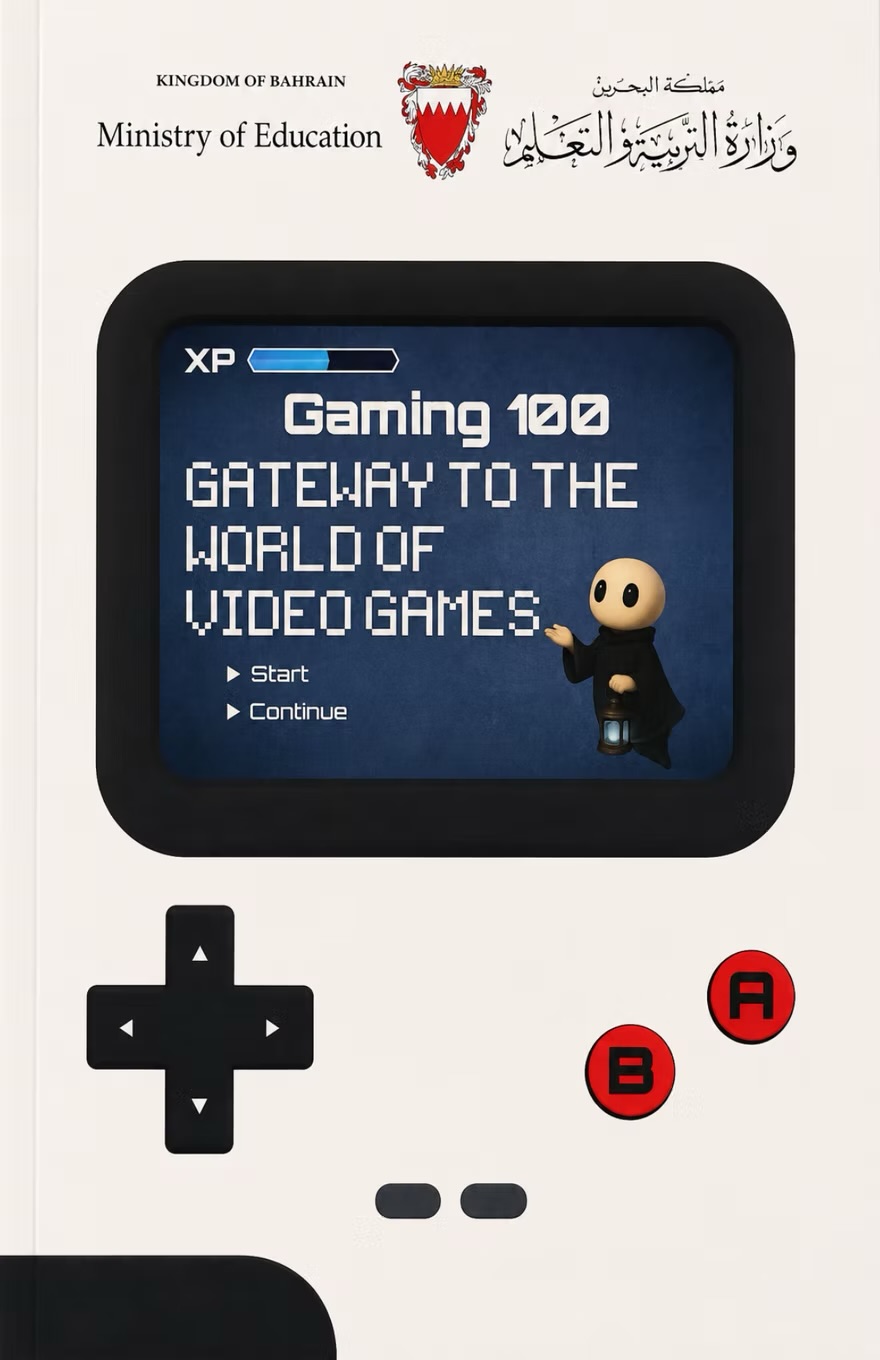
With the abundance of knowledge available to everyone on the internet, the task of the teacher is shifting toward that of an authoritative figure who curates the content the student must be exposed to. The school’s original task, since the days of Plato’s academy and Aristotle’s Lyceum, was to impart both essential knowledge and the skills required to obtain that knowledge. Schools also need to educate their students about the relevant pieces of information and skills that allow them to thrive in their societies. For example, as a student, I vividly remember how we were taught how to drive in school; it is not unbelievable that two generations from now all cars will be self-driving, and those skills would be obsolete to all but a select few. One course, which I will focus on in this article, is being developed for the state’s high schools in one gulf country. Its object is videogames.
What we have so far is its official textbook. On its first page, we are greeted with a typo: “GamIng 100” whereas it says “Gaming 100” on its front cover. Why they chose “100” instead of “101,” the typical label for an introductory course, is beyond me. The subtitle is as generic as it gets: “Gateway to the World of Videogames.” In the incorrectly titled “Introduction,” the minister of education prefaces the book with the now-exhausted speech about the need of a “forward-thinking education system” that has to prioritize “problem-solving-skills.” There, we are introduced to the cartoon character that will accompany us throughout the text, “Mr Gamer” [sic] himself. Among the team overseeing the project, we have the minister of education, a ‘serial entrepreneur,’ a ‘business owner,’ and a ‘gaming expert and Guinness world record holder’ [sic]. What a magisterial crew for such a splendid endeavor. How none of them caught the hybrid disaster of a Yoshi-Luigi speaks volumes about how polished this book is.
Chapter (§ 1) bears the title “Foundations of Videogame Culture & History.” It offers no such foundation, nor anything of use to the reader. The common videogamer probably knows more about videogames than all of the authors and editors of this volume, combined. We are not sure whether we are supposed to embrace the Videogame culture at all! Wasn’t it so that just in the other class (Islamic studies) students were taught that chess is forbidden in Islam because it distracts us and diverts our attention from prayer. Of course, that is not in the curriculum, but our teachers were always eager to volunteer such facts. What, then, can we say about the other games, the object of this class, that literally consume many gamers’ lives? In another class, on social and cultural studies, we were taught to avoid leisure. That we should be productive and prolific and not waste our times was a central idea, with a whole chapter dedicated to how this nuisance is fought world wide. What, then, do we do with this course? Since it encourages us to play video games, does it not go counter to what we were taught? To that end, our questions remain unanswered. Then, what culture are we to understand from this semester and embrace? Precisely that which our educational system deems to be wasteful and leisurely. I am utterly dumbfounded at how strange this whole affair is. The student is at a loss: Cognitive dissonance seems to be the goal.
We then go to (§ 4.20) which, out of all things, talks about “violence and addiction”! The section that follows (§ 4.21) discusses Ethics, Representation, and Diversity. Or, to be accurate, I must include the chapter title’s punctuation: “Ethics — Representation & Diversity.” What are we to make of that title? That ethics IS representation and diversity? Or did they use the em-dash as a comma?
Another thing regarding the heavy use of em-dashes that are strewn all over the text: They ultimately give away quite clearly that this whole book is AI generated from its first page till its last. How utterly embarrassing and shameful. This reminds me of an event that happened some years ago, when a friend sent me his paper to review before publication, and I realized that the 30-pages paper, which my work colleague in the biggest research institute in the country had ‘written,’ was actually co-written by an external collaborator, whom our friend had paid to contribute(!). I told him to throw it in the trash, as no self-respecting journal would dare touch this. It is sad that a whole ministry has no problem with publishing even worse. I have abandoned use of the em-dash altogether in fear of having my writings seen as suspect.
The book ends in chapter (§ 5) “Careers in Gaming.” The name itself is repulsive: It reads like propaganda. I was always amused at how much governments fight tooth and nail any type of innovation unless it wanted to sponsor it itself, and only after which, it would take all the credit. In the text itself, the authors confess that they (not they, but who they represent, the government) used to ban games (§ 2.9) in schools. Whence come these Pauline sentiments? Many of my friends had their videogame businesses destroyed by the ministry of interior and commerce because of their rigid and confusing regulations. Laissez faire! If you want a booming videogame industry, remove yourself; literally, stop interfering! It is often imagined that without a government subsidy, nothing would be accomplished. As if Einstein was tasked with the development of general relativity by higher-ups, or Dante was commissioned by the Pope.
I sent a message to the minister himself, informing him of the countless errors therein, but had redacted my message in fear of legal recourse. I had also told one of the authors that I think that this will prove to be a scandal and an unmitigated disaster. Of that, I am unsure. For, grievous errors abound in official textbooks, yet for decades, no one cared. The author asked me to email him with whatever errors I see in order to correct them in the next edition. But really, where to start? Am I being unreasonable to think that there needs to be complete, coherent, sentences in a school textbook? If the Japanese and American ministers saw the books and praised it, what does that say about this generation of buffoons?
If I were to write a textbook about videogames, the first objective I would attempt is to offer a provisional, pragmatic definition of what a videogame is. And only after this was accomplished, I would try to provide sufficient reasons to study this type of entertainment medium; why has this subject been elected over film, poetry, and so on is a question that merits its answer. To put this into perspective, I would have to answer to anyone who objects to this topic due to its consumerist nature. Because really, how can we condemn consumerism, whatever that meant by the critic, but then advocate for it in a full-fledged course?
And then, and only then, only after having defended this medium against its critics will I be able to discuss the topic at length. My primary focus would be on the analysis of the videogame medium. Other foci of no less importance are the study of the community of gamers, and specially the hyper focused groups, such as speed runners, reviewers, professional competitors. But then, so that this course would not be divorced from others in its neighborhood, appreciation skills would be the most important for a student to acquire. How can a student discuss a videogame, review it, write about it, and so on. These are the skills that videogames can be conduits for, which can be transferred to other art forms — if, indeed, videogame was a form of art: A fact that was not established in the text. This!, maybe this!, would be a legitimate focus instead of whatever straw we were asked to chew on!

