Introduction:
What is insanity? To what limit should people be believed? Is there a proper environment for our minds to function in, in order for us to be aware of the world in the usual sense? And moreover, is there a usual, proper, abundant, awareness of the external world that people tend to experience? Can we ever know what others think and believe? Leonora Carrington’s memoir, Down Below, invokes all these questions, and the reader is taken to the strange world of the author.
Leonora Carrington is an English painter and author born into a rich family and educated in the liberal arts. She eloped at the tender of 22 to France where she stayed with Max Ernst, a painter she admired. During the Nazi invasion of France, she tried to rescue the Jewish painter to no avail. She was transported to Spain in the following years where she soon lost sanity. The present book (1942, 1943) was originally written after her days at the mental asylum when she resided in New York, but the manuscript was forever lost. Our present volume of this work was dictated in French to Jeanne Megnen and then translated into English [1].
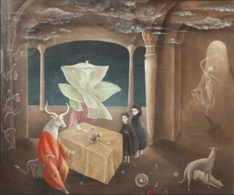
Down Below:
The book is presented as a genuinely insane account; i.e., the book aims to present an incoherent, episodic account of her days at the mental asylum in Madrid following her nervous breakdown. It is hard to read the book as anything but such. No doubt, its recount is poetic and artistic, but discontinuous, paranoid, fantastic, dream-like, and intentionally incredible.
Her tale starts in the South of France after her lover was imprisoned and all her attempts at rescuing him failed one by one. A friend of hers psychoanalyses her insufficiently, as the author reports, and tells her to find another lover. She tries to court a couple of men who are not interested in her after all, leaving her ‘undesirably chaste.’ Her living standards start to decline, and signs of a nervous breakdown start appearing. Some of her friends try to smuggle her into Spain, where she can be in a more peaceful environment. The road to Spain is long, and they meet many Nazi officers along the way. She becomes delirious, unable to walk well, and at some point, when their car breaks, she starts to believe that the problem with the car lies with her, now dysfunctional, stomach. She claims that she has become the car. They stop at several hotels on their way to Madrid, until they separate for a while each trying to find a way out of France. She meets another Nazi officer, Van Ghent, and she attempts to ask if he can help her lover, Max Ernst. He looks at her in contempt. She stays at a café for several days until on a strange event, she is approached by several officers who kidnap her, and take her to a Chinese room, ripping her clothes and raping her one by one. Surprisingly, she fights back but writes as if she did not mind that at all. The trip continues after the car is sold for a path out of France, and they leave for Spain. When they arrive, the author is in a state deemed by her psychiatrist to be incurably insane. She was given a spinal injection (systemic anesthesia), and admitted to a mental asylum in Santander, Madrid, under the supervision of Dr. Morales.
In the following chapter, she reports a fictional, fantastic, world where green eyes watch over her, where she is enclosed in a universal egg, and where all manners of strangeness appear. It is hard to report anything besides her spinal injections and her withering mental capacities, her squirming and wriggling, and her moans of pain. She fantasizes about a heavenly place in the asylum called Down Below — a basement of some sort to which she attributes all heavenly qualities. There is little to report here, but the rest of the book reads like an avant-garde painting. Eerie, metamorphous, and filled with ghosts: The asylum is a projection of her inner world, her own paintings in a physical setting.
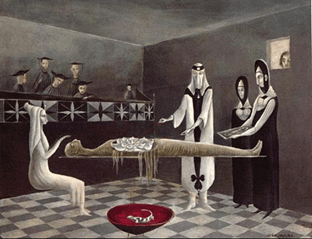
Analysis:
People use language for all sorts of reasons. They use language to describe the external world as well as their internal sentiments. They use language to discuss politics, negotiate prices, woo their love interests, tell stories, and report on their experiences. We know that people can be trusted on many issues, especially where we have a high level of confidence that they are disinterested in what they are describing. I always believe it when someone tells me he thought Bulgaria was more beautiful than Macedonia. I would only cast doubt on his claims if additional knowledge is gained on this person’s intentions — especially if perhaps his aim was not as honest as I thought it was. I would not question him if he told me he felt sick. But I would start questioning him if I felt he just wanted to return home and he would use any excuse. If he wanted to return home on that day, but I then discover that he has another occupation on that night elsewhere, I have grounds to question him, though I am not completely justified in my doubt. Philosophers tend to agree that certain things are very hard to doubt, whether they are true or not: These statements are said to be incorrigible. The only persons who can for sure know whether such statements are true or not are the very same persons who report these incorrigible statements.
To what limit should we believe those who feign insanity? There certainly are cases of schizophrenia in people, and many claim to suffer from hallucinations. Some take their lives when they reach a limit that they claim not to be able to bear anymore. But what about Leonora Carrington? A clearly impressionable woman, with artistic visions and a borderline personality. Upon reading Thomas Szasz’s ‘The Myth of Psychotherapy,’ one realizes that many instances of mental illness were shams. Often, dispositions not accepted by the wider society are considered mental illnesses, as the case of confining atheists in the early 20th century attests to [2]. And that the cure is not always better than the sickness, especially in the earlier days of psychiatry2, or in current treatments of children [3].
The story goes that a patient’s family approached Avicenna, the famous Islamic scientist and physician to cure their son who claims and acts as if he was a cow. Avicenna brought a scimitar to the son, who immediately jumped in fright and was instantly cured of his delusions. Now, of course, there are true cases of delusion, but to what limit are we to believe people who present these delusions, who claim that they suffer from auditory or visual hallucinations? Some might truly be telling the truth, but the inaccessibility of these claims makes it all the more impossible for us to be compassionate. In the memoir, the author demonstrates similar behaviors in her insanity as she does in her sanity. She lusts for her physician. She sees in the asylum the same creatures she painted before and after her incarceration. The conditions were really stressful, but the reader is not presented with much to believe anything.
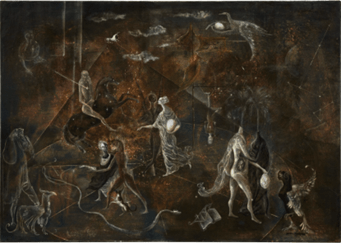
Closing Comment:
I read this book on a trip to my friend on a train to New York City, and it was an excellent book for the occasion. On my previous trip, I brought with me Guy de Maupassant’s memoir, and now this autobiographical sketch of insanity. There is nothing in particular that attracted me to the book, but I have been wanting to read this volume for a long time. It was on my shelf for over eight months and has been on my to-read list for three years. Now that I have finally read it, I am glad to see something fresh, but in reflection, I understand that not all fresh things are worth one’s time. I could not concentrate as the book was very disoriented and disorienting. And frankly, it is dull by itself. I am not fascinated by her imagination, and I am even less fascinated by her paintings. But the question this book raised made it worthwhile. And to that, I can only recommend this book to a select few who want strangeness for its own sake, and not too many more for little is lasting in this short volume of insanity.
[1] Leonora Carrington, Down Below, NYRB, 2017, p. 69 (Note on the Text).
[2] Thomas Szasz, The Myth of Psychotherapy, Syracuse University Press, 1988.
[3] Leonard Sax, The Collapse of Parenting, Basic Books, 2015; Sally Satel and Christina Hoff Sommers, One Nation Under Therapy, St. Martin, 2006.
Rochester, New York,
June, 2022.

