How many times have you heard someone describe an idea as logical when he thinks it is plausible or convincing, and illogical when it is weird or improbable? Worse, how many times have you heard someone describe an opinion as logical when he is persuaded by it, or illogical when he wants to dissuade others from accepting it? It might be surprising to the reader that these are abuses of the adjectives ‘logical’ and ‘illogical,’ as they go counter to the whole spirit of the discipline of logic. Logic is interested in necessary results. These results may be strictly false, but they were correctly inferred on account of their being logical. They may have been poorly presented as well, and this makes them less agreeable to us, even though that does not affect their validity at all! Logic is not the science of ‘Truth’: that science is epistemology; neither is it a science of persuasion: that is rhetoric. Logic, as a science, is primarily interested in inference, and specifically, in deductive and inductive inferences. And whereas deductive inference results in necessary results, inductive inferences lead to results that are necessarily probabilistic, and often (but not always) probabilistically necessary. Logicians still study epistemology and rhetoric, and they contribute to these fields. They do so, however, in pursuit of their auxiliary benefits to logic, and not because these are core components of the field. In this article, we aim to explain what we mean by logical inference through syllogisms, the simplest objects in formal and syllogistic logic.
Validity.
The adjectives, logical and valid, are true of inferences and arguments, respectively. A logical inference is one that takes account of the qualities of some propositions to extract an uncircumstantially true proposition that follows from the input. A valid argument is one that has such a form that produces necessary results, if the propositions were sound (sound means true, but more on this later). A common example beloved by logicians studies the mortality of Socrates:
All men are mortal;
Socrates is a man;
Thus, Socrates is mortal.
You may recall from the previous article that this syllogism has the form (AAA-1). (Note that the minor proposition is A and not I: ‘Socrates‘ should be read as ‘All persons who are Socrates.’) This argument is valid. This means that if all the premises are true, the result has to be true. In fact, all (AAA-1) syllogisms are unconditionally valid: the unconditionality simply tells us that the result doesn’t say anything more than what is contained in the premises.
As you can see, these adjectives cannot be true of statements. A logical inference means an inference that produces a premise that follows necessarily from other premises. None of the premises themselves is logical. Logical is a property of the process through which we derive the result. As for validity, it is a technical term that shows us which syllogisms, say, must produce correct results if their premises are correct.
One cannot call opinions or facts valid, as that constitutes a special type of error called a categorical error. It is the same type of error we make when we say that the color red is sweet, or the afternoons at Aunt Leila are rectangular. Statements such as ‘X is Y’ require understanding what kinds of properties are true of X, and the knowledge that Y can be attributed to X and is, in fact, attributed to X. Such statements are said to be ‘sound,’ a general term denoting factual (scientific or analytic) premises. Let us assume that all statements henceforth are sound, and consider the types of valid arguments possible.
Distribution, Polarity, and Existential Import.
In general, all premises can be written in the form ‘X is Y.’ However, it is possible to make assertions more fruitful by adding quantifiers and affirmative or negative polarities to our copulas (is/are). Let us start with quantifiers. There are two quantifiers in logic: All, and some. When we want to say that ‘an apple is a fruit,’ we write this in the standard form as:
All apples are fruits. (A)
‘All’ is the universal quantifier. It signifies that all the things that come immediately after it are the subjects of the premise. Logicians call this property ‘distribution.’ No apple is disqualified from (A). We could easily say ‘all apricots are fruits,’ or ‘all figs are fruits,’ and so on. These all exhibit distribution, as the properties being attributed to the subject is distributed to all entities which are the subject. Here is a Venn diagram.
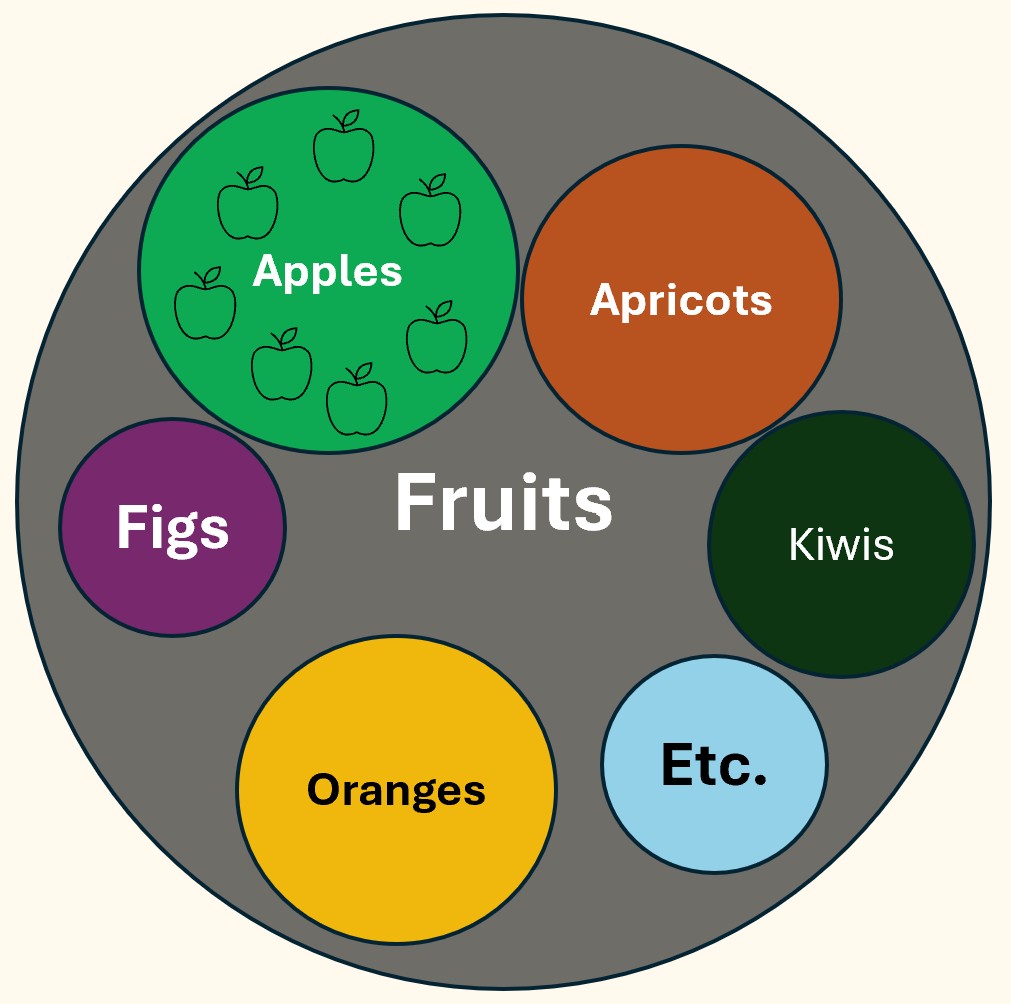
Some quantifiers do not distribute. ‘Some’ is a nondistributive quantifier. The greatest differences between ‘some’ and ‘all’ are subtle. To fully understand these differences, let us consider symmetry and existence. First, the existential quantifier, ‘some,’ is symmetric.
If
Some oranges are fruits, (I)
then
Some fruits are oranges. (I)
The same is not true of the universal quantifier, all:
If
All figs are fruits, (A)
then it is not necessarily the case that
All fruits are figs. (A)
The polarity of the copula (is/are) can be affirmative or negative. Both (A) and (I) are affirmative. The situation is reversed when we reverse the polarity, because a negative copula is always distributive:
If
All kiwis are not mammals, (E)
Then
All mammals are not kiwis. (E)
And if
Some horses are not unicorns, (O)
Then it does not follow that
Some unicorns are not horses. (O)
In the first example, all kiwis are the subject of the premise, and all mammals are disqualified. But then, it would equally be the case that the opposite is true, that all mammals can be the subject and all kiwis are disqualified if the first premise is true, because all terms are distributed. In the second example, horses (1) are said to exist, and that (2) they are not unicorns. The converse: That unicorns (1) exist, and that (2) they are not horses, is incorrect because they do not agree on (1).
As for the third property, it is the most complicated. It separates Classical (Aristotelian) Logic from Mathematical or Modern (Boolean) Logic. In both Classical and Modern Logic, (I, O) premises assume the existence of the term following the existential quantifier. ‘Some’ ensures the existence of at least one specimen of the subject. ‘Some apples are green’ actually means: “At least one apple exists, and that apple is green.” The same is not true about the universal quantifier. In Boolean Logic, the universal quantifier does not assume the existence of any specimen from the subject; i.e., (A, E) premises do not have existential import. This is exemplified in the previous example with the existence of horses and unicorns in (1).
If
All unicorns have horns, (A)
Then it does not follow that
Some unicorns have horns. (I)
So far, this is not controversial, since unicorns do not exist. However, the difference is most manifest when we return to our example on apples. In Aristotelian logic, it is impermissible to attribute a property to a nonexistent subject, and the universal quantifier assumes the existence of the subject. This follows:
Aristotelian Logic:
If
All apples are fruits, (A)
Then
Some apples are fruits. (I)
In mathematics, mathematical logic, and modern logic, we have no issue with attributing properties to nonexistent subjects. There is no problem with a premise like ‘All unicorns have horns,’ because it is read as ‘if unicorns exist, then all unicorns have horns.’ It does not matter if any unicorn exists for the previous conditional statement to be correct. Another difference is that the universal quantifier does not suppose the existence of the subject. An inference of an (I) from an (A) is called the existential fallacy in Boolean Logic.
Boolean Logic:
If
All apples are fruits, (A)
Then, it does not follow that
Some apples are fruits. (I)
The resultant premise, even if true, cannot be inferred from the former premise, so this is a false inference.
Unconditionally and Conditionally Valid Syllogisms.
Now, we can summarize by enumerating all conditionally and unconditionally valid statements. Conditionally valid statements require the existence of some terms to be true in Aristotelian Logic, whereas unconditionally valid statements are true in both Boolean and Aristotelian Logic. We have four forms of premises:
A: All S (subjects) are P (predicates);
E: All S are not P (No S is P);
I: Some S are P;
O: Some S are not P.
We also have four figures.
| Figure/Premise | 1 | 2 | 3 | 4 |
| Major | M – P | P – M | M – P | P – M |
| Minor | S – M | S – M | M – S | M – S |
| Conclusion | S – P | S – P | S – P | S – P |
For example, an EIO-3 syllogism looks like this:
All M (middle term) are not P (predicates)
Some M are S (subjects)
Thus, some S are not P.
Where P is called the major term, S the minor term, and M the middle term. From a combinatorial analysis, we see that we have a major and minor premise, and a conclusion, each of which can have any of the four forms and any of the four figures. This leaves us with 4 x 4 x 4 x 4 = 256 syllogisms. Only 24 arguments are valid: 15 of which are unconditionally valid, and 9 of which are conditionally valid (we will put the term whose existence is required for the syllogism to be valid in parenthesis).
| Figure 1 | Figure 2 | Figure 3 | Figure 4 |
| AAA | AEE | AII | AEE |
| EAE | EAE | IAI | IAI |
| AII | EIO | OAO | EIO |
| EIO | AOO | EIO | AEO (S) |
| AAI (S) | AEO (S) | AAI (M) | EAO (M) |
| EAO (S) | EAO (S) | EAO (M) | AAI (P) |
Let us look at two examples. (AOO-2) are unconditionally valid. This means that if the major and minor premises are correct, then the conclusion is necessarily true:
[Major premise] All apples are fruits;
[Minor premise] Some worms are not fruits;
[Conclusion] Thus, some worms are not apples.
In the same figure, (AEO-2) is conditionally valid. The minor term, ‘worms,’ has to exist for the conclusion to be true.
[Major premise] All apples are fruits;
[Minor premise] All worms are not fruits;
[Conclusion] Thus, some worms are not apples.
It is obvious that the conclusion is true. It’s not just the case that some worms are not apples, but we know it for a fact that all worms are not apples. But this is beside the point. We cannot infer the conclusion in Boolean logic, but we can in Aristotelian logic only when both premises are correct (and therefore, there are such things as apples and worms).
What we have done in this article so far, only this method of thinking, only these processes, may be called logical — as in, logical inferences. These habits of thinking in formulae and in a sequenced, and ordered, way, is the logical way of thinking. Thought that is not ordered or scrutinized is not logical, even if it is true.
Note: Some of the material here has been taken directly from my lecture notes for a course I designed to be taught to researchers at the Kuwait Institute for Scientific Research, which I delivered in 2023.
 Derbeel Q8